
A TAVOLA: Cities That Know How to Eat & Drink - Trieste
Updated: 3 days ago

Where Italy Meets Vienna — and Nobody Agrees on How to Order Coffee
Trieste is Italian, but it doesn't always eat like Italy.
Sitting on the Adriatic, with Slovenia just around the corner and Austria never far from its history, this is a city where espresso meets apple strudel, seafood shares the table with sauerkraut, and a plate of pasta might be followed by something involving cinnamon, walnuts and rum.
The architecture feels Viennese. The sea is unmistakably Mediterranean. The cafés look like they were designed for people with absolutely nowhere else to be.
And the food?
A delicious identity crisis.
Except Trieste knows exactly what it's doing.
1. The Port That Changed What Italy Drank

In 1719, Emperor Charles VI declared Trieste a free port of the Habsburg Empire.
That decision transformed a relatively modest Adriatic town into one of Europe's great trading centres.
Ships arrived carrying goods from across the Mediterranean and beyond. Merchants, sailors and traders brought their languages, traditions and appetites.
But one particular cargo would help define the city.
Coffee.
Trieste became a major European gateway for coffee, and the city's grand cafés developed into gathering places for writers, artists, intellectuals and anyone who believed a conversation deserved another espresso.
Unlike much of Italy, where coffee is often a quick stop at the bar, Trieste also embraced the Central European tradition of lingering in beautiful cafés.
A newspaper. A small table. A strong coffee. An argument about something important.
Then another coffee because nobody has finished arguing.
Now that's a civilized morning. Port of Trieste 300
2. Jota Triestina

Forget everything you think you know about Italian soup.
Jota is what happens when Italian cooking heads north, meets Central Europe and decides everyone should get along.
This thick, comforting soup combines beans, potatoes and sauerkraut, often enriched with pork, garlic and sometimes smoked meat.
It arrives steaming, with the unmistakable aroma of slow-cooked pork and that slightly sharp, fermented fragrance of sauerkraut.
The first spoonful is rich and earthy.
Then comes the acidity.
The beans soften everything. The potatoes give it body. The sauerkraut cuts through the richness and keeps you coming back.
It's hearty, rustic and unapologetically filling.
Traditionally associated with the colder months, jota is the kind of food that belongs in a family kitchen when the wind is howling outside.
And in Trieste, that wind has a name.
The Bora.
When it blows down from the northeast, a bowl of jota suddenly seems less like lunch and more like survival equipment. Turismo FVG
3. Presnitz
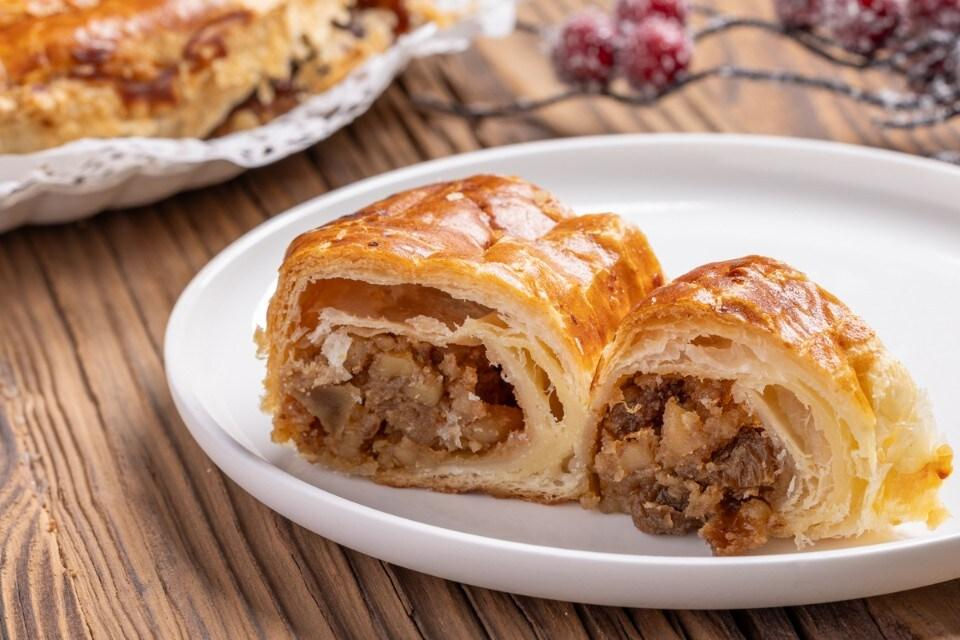
Now for something completely different.
Presnitz is one of Trieste's great pastries, and it looks as though somebody decided a simple dessert wasn't nearly ambitious enough.
A thin pastry is wrapped around a rich filling of walnuts, almonds, raisins, pine nuts, candied citrus, chocolate and warm spices, often with a generous splash of rum.
Then it's rolled into a spiral and baked until golden.
Slice into it and you get layers of crisp, buttery pastry surrounding a dense, fragrant filling.
Toasted nuts. Cinnamon. Citrus. Dark chocolate. A little rum.
It's rich without being overly sweet, and every bite seems to reveal another ingredient.
Presnitz reflects Trieste's Austro-Hungarian heritage and remains particularly associated with holidays and family celebrations.
It's the sort of dessert that appears after everyone has insisted they couldn't possibly eat anything else.
Then somebody cuts it.
And suddenly there's room. Turismo FVG
4. Vitovska & the Capo in B

Just above Trieste lies the Carso, a rugged limestone plateau where vineyards grow among stone walls, red earth and windswept hills overlooking the Adriatic.
One of its most distinctive wines is Vitovska.
This indigenous white grape produces wines that are typically dry, fresh and savoury, often showing delicate orchard fruit, herbs and a mineral character.
It's not a wine that tries to overwhelm you.
It's a wine that belongs beside food.
Pour a glass with seafood, prosciutto or a plate of local cheese, preferably at an osmiza — a traditional farmhouse gathering place where producers serve their own wine alongside simple local food.
No elaborate presentation.
Just wine, salumi, cheese and people sitting around a table.
We could get used to that. Turismo FVG
But Trieste's other great drink deserves its own introduction.
Meet the Capo in B.
Order a regular cappuccino in Trieste and you'll be understood.
Order a capo in B and you'll sound considerably more local.
It's a small espresso with steamed milk and foam, served in a little glass rather than a traditional cup.
And because Trieste takes coffee seriously, it has developed an entire vocabulary around ordering it.
A nero is an espresso.
A capo is a macchiato-style coffee.
A capo in B comes in a glass.
Apparently, even coffee needs its own dialect.
We respect the commitment. Slow Italy
5. Why Bar Corso Loves Trieste

Trieste reminds us of something important about Italian food and drink:
Italian tradition has never existed in isolation.
It's been shaped by trade, travel, neighbours, immigrants and centuries of people sharing ideas around the table.
Trieste just makes those influences a little more obvious.
Austrian pastries. Slovenian traditions. Italian coffee. Adriatic seafood.
Beautiful wines from the surrounding hills.
And perhaps most importantly, a culture that understands the value of simply spending time together.
That's something we love at Bar Corso.
Our menu celebrates Italian ingredients and traditions, but what interests us most isn't following a rulebook.
It's understanding why things work.
Why a little acidity makes a rich dish better.
Why the right wine can transform something simple.
Why a bitter aperitivo prepares you for dinner.
And why a small plate shared between friends can sometimes be more satisfying than an elaborate meal.
Trieste also understands the pleasure of a proper bar.
Not somewhere you simply stop to drink.
Somewhere you meet. Talk. Eat something. Stay longer than planned. And perhaps order one more.
At Corso, we might lean more toward Negronis and amaro than Trieste's famous coffee culture, but the philosophy is remarkably similar.
Good food. Interesting drinks. Great company.
And absolutely no reason to rush.


