
A TAVOLA: Cities That Know How to Eat & Drink
VENICE
Where Dinner Starts Standing Up - Vino Vero in Venice

Venice is one of the most photographed cities in the world, which is unfortunate in one respect: everyone is so busy looking at it that they can forget to eat like a Venetian.
Step away from Piazza San Marco and into a neighbourhood bacaro and Venice changes.
A tiny glass of wine lands on the counter. A plate of cicchetti follows. Someone orders another. Then another.
Dinner hasn't officially started, it may never officially start, and that's exactly the point.
1. The City That Put Spice on the Italian Table

Long before Venice became a tourist destination, it was one of Europe's great trading cities.
Ships arrived carrying pepper, cinnamon, cloves, nutmeg, dried fruits and other ingredients from the eastern Mediterranean and far beyond. Venetian merchants didn't just become wealthy selling them — those flavours worked their way into the city's kitchens.
And you can still taste that history.
Venetian cooking has combinations that can seem unusual elsewhere in Italy: sweet with sour, fish with raisins, onions with vinegar, warm spices beside savoury meats and seafood.
It helps explain why Venetian food tastes so different from the cooking of nearby inland cities.
This was a city eating globally centuries before anyone used the word fusion.
And perhaps that's the most interesting thing about Venice's food.
For all the city's devotion to tradition, Venetian cuisine was shaped by people bringing new things home.
2. Baccalà Mantecato

Few Venetian dishes are more deceptive than baccalà mantecato.
It doesn't look particularly dramatic.
Dried cod is slowly cooked, then worked with oil until it becomes pale, creamy and almost impossibly light.
Spread it generously over grilled polenta or warm bread and you get something simultaneously salty, silky and deeply savoury. It's one of the classic cicchetti you'll find in Venetian bacari.
There's no tower. No garnish forest. No explanation from somebody holding tweezers. Just fish, oil, bread and a glass of wine.
Perfect.
3. Sarde in Saor
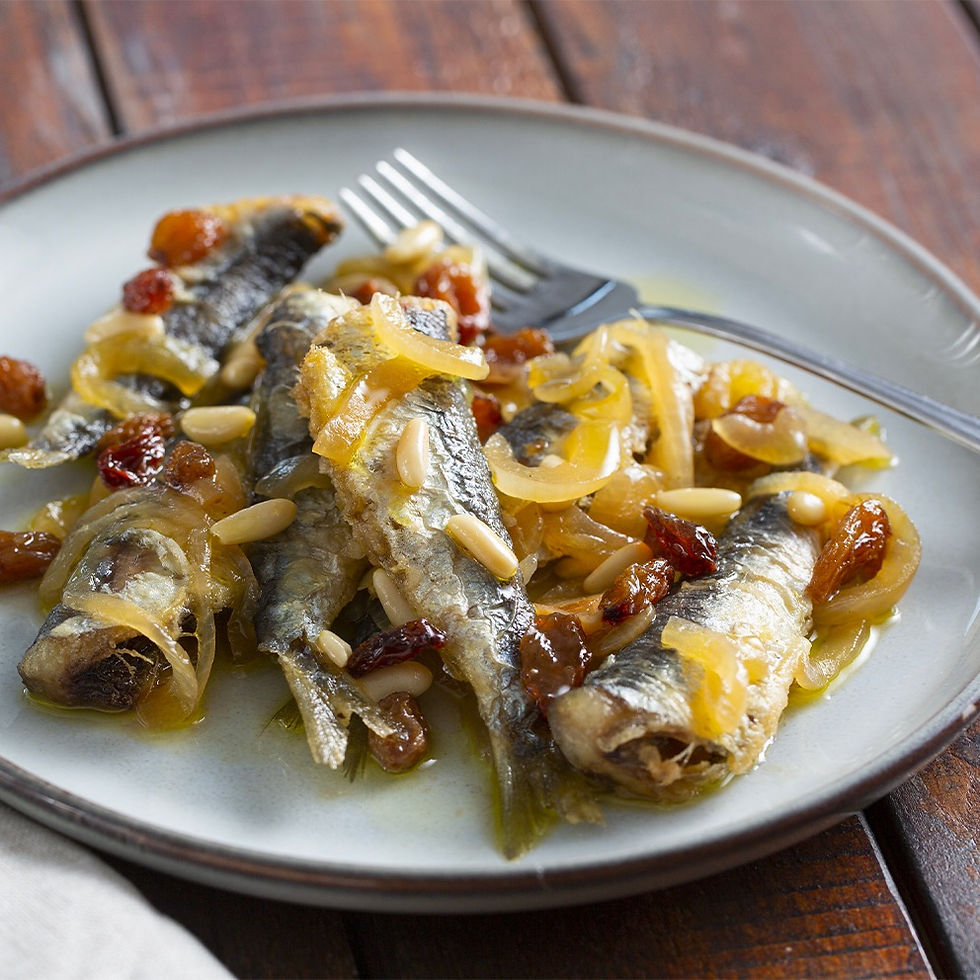
Then Venice gives you a dish that tastes a little like the city itself.
Sarde in saor.
Fried sardines are layered with soft onions cooked with vinegar, then traditionally finished with raisins and pine nuts and allowed to rest.
Sweet onion. Raisins. Crunch from the pine nuts. It's salty, sweet, sour and savoury all at once.
And because it improves after resting, it became exactly the kind of food sailors could carry — before eventually becoming a fixture on Venetian counters.
Today, you'll often find it among the cicchetti in a bacaro.
Which brings us to the really important part.
What are we drinking?
4. Soave & the Venetian Ombra

Veneto gives Venice an embarrassment of wine choices, but beside lagoon seafood we'd happily pour Soave.
Made primarily from Garganega grown on the hills east of Verona, good Soave is dry, fresh and gently aromatic, often finishing with that slightly bitter edge that makes another sip remarkably easy.
But the drink that really explains Venice isn't a particular grape.
It's an ombra.
An ombra is a small glass of wine taken at a bacaro, usually accompanied by one or two cicchetti.
And this is where Venice gets dangerously good at drinking.
You don't necessarily sit down for three hours. You stop. Order an ombra. Eat something. Talk. Walk to another bacaro. Repeat.
In Cannaregio and other neighbourhoods, bacari remain part of everyday Venetian aperitivo culture, serving little glasses alongside classic cicchetti.
It's essentially a Venetian bar crawl.
Except with better snacks.
We approve.
5. Why Bar Corso Loves Venice

Venice understands something we love at Bar Corso:
you don't always need to decide whether you're having a drink, an appetizer or dinner.
Sometimes you just start. A little glass of wine. Something salty. Another plate. Another drink. Someone else arrives. Suddenly you've been there two hours.
That's the magic of the Venetian bacaro, and it's very close to what we love about Italian drinking culture in general.
Food and drink aren't separate events.
They keep each other company.
A bitter aperitivo makes you hungry. Cicchetti make you thirsty. Wine encourages another plate. And eventually someone suggests amaro because apparently nobody has anywhere to be tomorrow morning.
That's pretty close to our philosophy on Commercial Drive.
Put a Negroni on the table. Add a few small plates. Open some wine. Don't over-plan the evening.
Let dinner happen to you.
Venice has been doing that for centuries.


